Why is the research into Unidentified Anomalous Phenomena getting (UAP) Still so little serious scientific attention? In a new paper from the UAP Coalition Netherlands, Tony Suurendonk examines the underlying causes of stigma in this field and the need for an open, scientific approach.
For decades, unexplained phenomena have been observed worldwide by professionals such as pilots, police officers, and military personnel. Despite these reports, the scientific community remains hesitant. The reason for this is not a lack of data, but a persistent social and professional stigma.
The paradox of the three percent
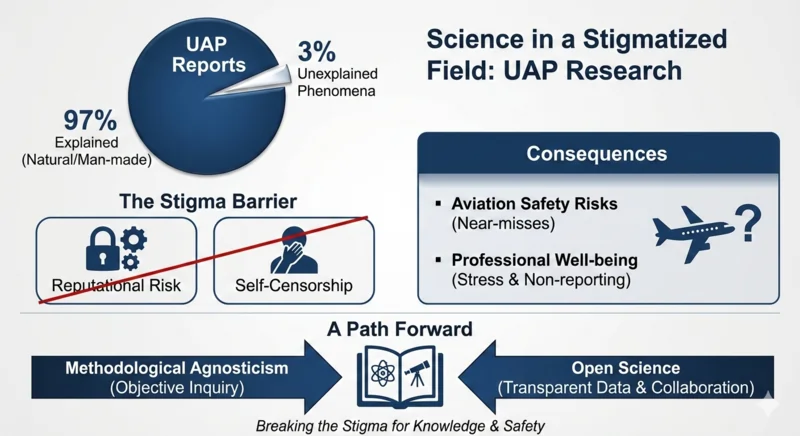
Research by both private and official agencies shows that the vast majority of UAP reports (95 to 97 percent) can be explained by everyday factors such as balloons, aircraft, or atmospheric effects. However, Suurendonk's paper focuses specifically on the remaining three percent of cases that remain unexplained, even after thorough analysis.
A paradox prevails within science: topics that demand critical scrutiny are often avoided for fear of reputational damage. This leads to self-censorship among scientists, who fear for their funding or exclusion from academic debate.
Consequences for safety and well-being
Stigma isn't just an academic problem; it has direct implications for practice. The analysis shows that:
- Aviation safety: Pilots report dangerous situations and near misses with unexplained objects.
- Underreporting: For fear of being labelled “crazy” or losing their pilot's license, many professionals do not report their sightings or report them incompletely.
- Health: Suppressing these experiences can lead to stress, emotional burden and psychological complaints among professionals.
A New Path: Methodological Agnosticism
To break this taboo, the paper advocates for "methodological agnosticism." This is a research approach also used in the social sciences. In this approach, scientists investigate phenomena objectively and with analytical rigor, without making prior assumptions about the nature or truth of the phenomena.
International movement
Fortunately, a shift is visible. Worldwide, initiatives are emerging that approach UAP from a strictly scientific perspective, such as Harvard's Galileo Project and NASA's independent study team. In Europe, too, with organizations like France's GEIPAN, the call for transparent data and interdisciplinary collaboration is growing.
Breaking the stigma is essential. Only by seriously investigating UAP using existing scientific methodologies can we improve safety in our airspace and expand our knowledge of the reality around us.
About the author: Tony Suurendonk, MSc, is a healthcare psychologist and affiliated with UAP Coalition Netherlands as a researcher and advocate.
Would you like to know more? Download the full paper here: “Science in a Stigmatized Field”