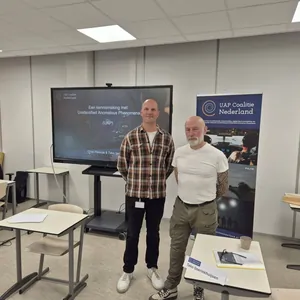
Students of ROC Nijmegen recently attended a guest lecture several times within the Citizenship subject about Unidentified Anomalous Phenomena (UAPThe goal of this guest lecture was to reinforce important skills, such as source analysis, recognizing stigmas, and carefully forming one's own judgment, not to speculate on the origins of these phenomena.
In citizenship education, it is important that students learn to deal with a complex information society. The subject of UAP offers an excellent practical case study for this. Although UAP itself is used by various countries and agencies such as the Dutch Safety Board, the American space agency NASA and the Pentagon When a factual reality is acknowledged, interpretations are often influenced by assumptions, perceptions, and media attention.
No speculation, but analysis
The Citizenship teaching team deliberately chose to collaborate with UAP Coalition Netherlands to allow students to view information from different perspectives. These lessons were developed in collaboration with the ROC Citizenship team, which was in 2025 declared to teaching team of the year. The lessons focus on facts and on the way information is presented by governments, organizations, and the media. By leaving science fiction and subjective interpretations out of consideration, the focus remained on a down-to-earth and investigative approach to the subject.
During the interactive sessions, case studies, video clips, and group assignments were used to encourage students to actively reflect on how information is generated and interpreted. A retired pilot also engaged in a discussion with the group about his own UAP observations and the reluctance pilots often experience to speak openly about them.
Critical thinking and an inquisitive attitude
During the meetings, three important themes were central:
- Source criticism: How do you distinguish factual reports versus speculative reports?
- Stigmatization: What is the impact of bias on public and scientific debate?
- Government communication: How transparent are official bodies about their findings?
By approaching the theme as an issue of information provision and observation, the educational institution aligns with the growing need for critical looking and careful handling of complex information.
The lessons encourage students to adopt an inquisitive attitude: not drawing conclusions too quickly, comparing different perspectives, and leaving room for nuance and uncertainty.
With this approach, UAP Coalition Netherlands helps students develop citizenship skills that they can also apply to other complex social and political issues in their future careers.
The guest lectures have since been positively evaluated and will be continued at ROC Nijmegen.